Why Sansa Sews
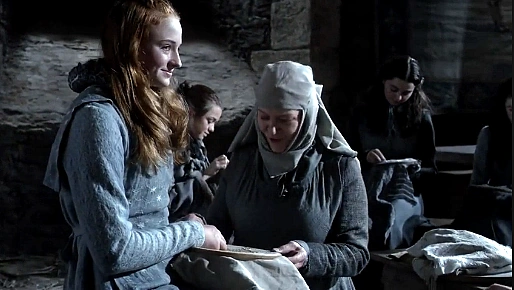
The character Sansa Stark in HBO’s Game of Thrones is the most recent example of a common stereotype of the medieval woman as textile worker: an elite woman, the elder daughter of one of the most powerful families in the Seven Kingdoms, she works on textiles, makes her own clothes and practices embroidery, not because she has to, there must be other textile workers who produce the clothing worn by the other characters in this world and who could make hers as well, but as a marker of proper femininity.
This meaning for Sansa’s textile work is made clear from the beginning of the HBO series, as is shown in the image above from Season 1. Here Sansa shows her embroidery work to the septa who serves as a governess for her and her sister Arya, the septa praises Sansa’s work, and she beams in response. In the background, Arya and other girls work on their embroidery; Arya we later learn, doing so with much less success than her sister. This difference around textile work comes to distinguish between the two sisters in their relationships to norms for femininity in their world. Sansa will strive to fulfill those norms as she strives for excellence in her textile work and for approval from female authority figures. Arya will reject feminine norms and appropriate instead forms gendered as masculine. One of the most obvious of these is her interest in sword fighting: to heighten the contrast between her and her sister, she will name her sword Needle.

The dynamic between Sansa and the septa is repeated, with a twist, in one of Sana’s first interactions with Queen Cersei, who acts at this point as another female authority figure who Sansa hopes to please. At a feast at Winterfell, Sansa’s family castle, Cersei asks if Sansa made her dress herself, Sansa again beams at the attention her sewing skills are bringing her, and Cersei states that someday Sansa should make a dress for her.


The twist here comes from the fact that the dress Sansa has made for herself is rather hideous. And so Cersei’s praise of it can’t be serious. The result is to identify Sansa at this point as a naïve girl who is unprepared for the life at court that she will soon enter. Once at court in King’s Landing, and then as she travels through the Seven Kingdoms, Sansa will have to grow up quickly and leave that naïve girl behind. Much has been written about how her changing wardrobe marks that change in her character. But she keeps sewing: multiple scenes show her doing so in various settings.


These scenes of Sansa sewing are strikingly similar. Each shows her seated and still except for her moving hand or hands. Her head is bowed down over her work and her eyes are lowered to it. She is alone or accompanied by a shadowy figure with whom she doesn’t interact. The gif format that has been given to these scenes for redistribution online emphasizes the repetitive nature of her work as she stiches on and on forever. These gifs have been posted together on multiple websites (see here, here, and here). Seeing them together serves to emphasize the similarities between them, similarities that promote a specific idea of the medieval woman as a textile worker. She works on her own in private spaces, whiling away long hours with repetitive work. She is passive and still, quiet and docile.
The problem with the image Sansa presents of the medieval woman as textile worker is that it is largely a product of the 19th century and so has little to nothing to do with what women’s lives and experiences in the Middle Ages were actually like. The 19th century origins of these ideas are illustrated by the text of an article on medieval embroidery from 1845:
 |
Charles
Henry Hartshorne, “English Medieval Embroidery,” Archaeology Journal
1 (1845): 318.
|
The image of Sansa as a textile worker in Game of Thrones does something similar. It uses her sewing as an emblem of what we would now consider to be a more traditional or conservative form of femininity and projects that version of femininity back into the Middle Ages as a remote past – there to be either embraced or rejected. Through her textile work, Sansa either represents femininity in the way it has always been and so should continue to be, or she represents femininity the way it used to be in the bad old days that we can celebrate ourselves for having moved beyond.
But what happens if we recognize that this image of the medieval woman as textile worker is simply inaccurate? How can that change our understanding of women and of textile work in the medieval past, in the 19thC, and in our present day?
Next: Medieval Women as Textile Workers


Comments
Post a Comment